The likelihood of someone guessing a 4-digit PIN correctly on the first try is 1 in 10,000 (or 0.0001), but this assumes a completely random distribution; in reality, some PINs are much more common, increasing the likelihood of a successful guess. [1, 2, 3, 4]
Here’s a more detailed breakdown: [1, 2, 5]
- Possible Combinations: For a 4-digit PIN using numbers 0-9, there are 10,000 possible combinations (10 x 10 x 10 x 10). [1, 2, 5]
- First Attempt Probability: Therefore, the theoretical probability of guessing the correct PIN on the first try is 1/10,000. [1, 2]
- Real-World Scenarios: However, people often choose predictable or easily remembered PINs, such as: [1, 3]
• 1234, 1111, and 0000 are very common, making them easier to guess. [1, 3]
• Studies have shown that these 3 numbers represent almost 20% of 4 digit-codes samples taken [1] - Common Trends: Other common PIN patterns include repeating digits (e.g., 1111, 2222), sequential numbers (e.g., 1234, 2345), or numbers related to birthdays or anniversaries. [1, 3]
- Implications: The likelihood of someone guessing a PIN successfully depends heavily on how random the user’s chosen PIN is and also if they use common PINs. [1, 3, 6]
Generative AI is experimental.
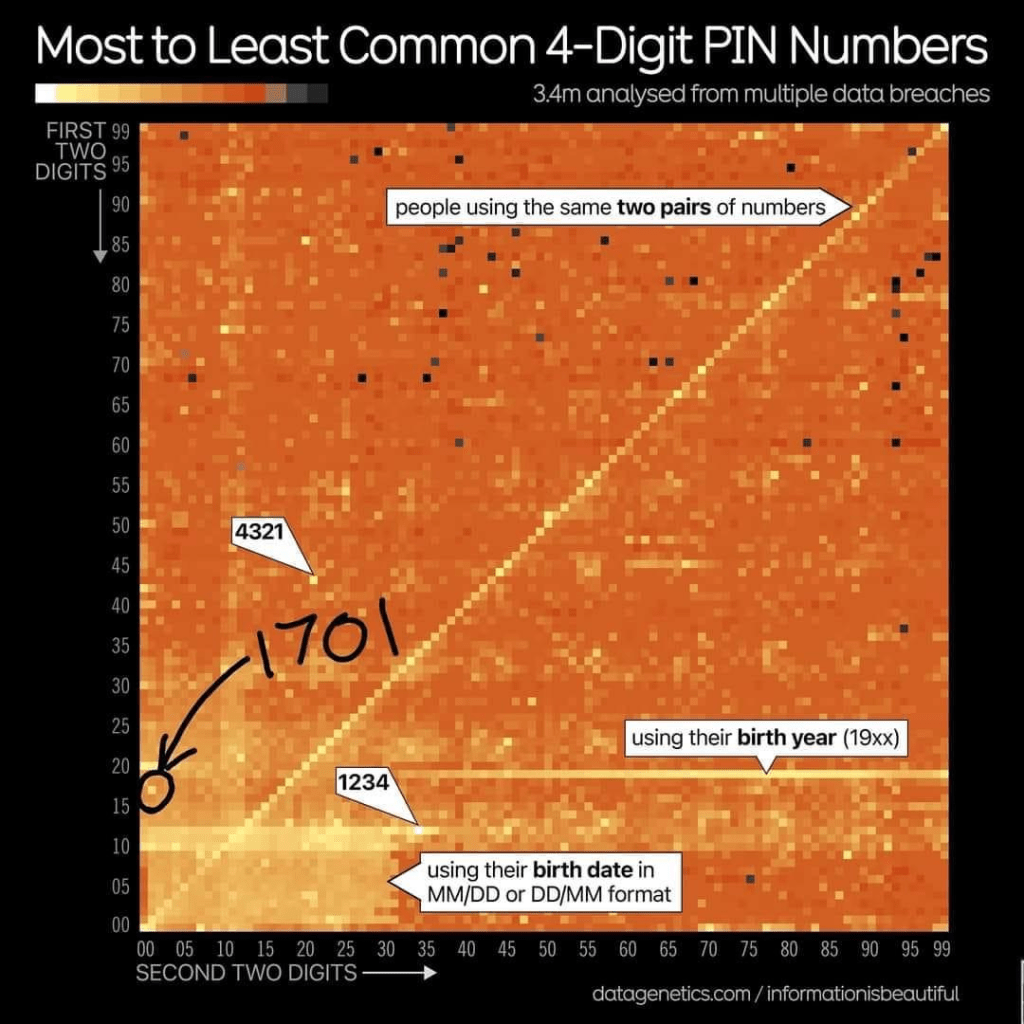
Going to revisit, the math…. look at it for the time being…

trying to get in a building…
0911 and the rest… guess away…
 AlienChaos...
Leave a comment